January 15, 2009
A Happy Ending
I was terrified when I first read the headline. But, thanks to a skilled pilot, all of the passengers and crew survived.

US Airways Flight 1549 pilot Chesley B. "Sully" Sullenberger III has been hailed as a hero for safely landing the plane after two engines blew out Thursday in New York City. The captain for US Airways has more than 40 years of flying experience, according to a safety Web site.


Article here
All safe after US Airways jet goes down in New York's Hudson River
The pilot is praised for saving Flight 1549's 155 passengers and crew. The plane traveling to Charlotte, N.C., lost power after apparently hitting a flock of birds.
By Geraldine Baum and Michael Muskal
6:56 PM PST, January 15, 2009
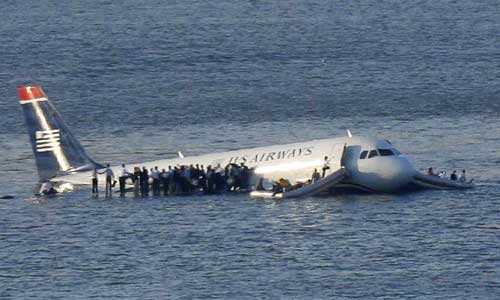
Reporting from Los Angeles and New York -- A US Airways plane made an emergency landing into the icy waters of the Hudson River today, and the pilot was being called a hero for keeping about 155 passengers and crew alive after his craft was forced down moments after takeoff from New York City.
The cause of the crash will be investigated, city, state and federal officials said, but early reports indicated the plane may have hit some birds, causing its engines to lose power.
"We've had our miracle on 34th Street," New York Gov. David Paterson told a televised news conference this evening. "Now we've had a miracle on the Hudson."
"This pilot somehow, without any engines, was able to land this plane and perhaps without any serious injuries to the passengers," he said.
New York Mayor Michael R. Bloomberg praised the pilot as well.
"It would appear the pilot did a masterful job of landing the plane in the river and then making sure everybody got out," the mayor said. "I had a long conversation with the pilot, and he said he walked the plane twice after everybody was off to verify nobody else was on board."
The pilot was identified as Chesley B. "Sully" Sullenberger III of California's Bay Area.
Sullenberger has more than 40 years of flying experience, the last 29 as a captain with US Airways. A former fighter pilot and captain with the United States Air Force, Sullenberger has also served as a local safety chairman and accident investigator for the Air Line Pilots Assn., according to his resume posted on the Web.
US Airways Flight 1549 was en route to Charlotte, N.C., when it lost power after takeoff from Runway 4 at LaGuardia Airport about 3:26 p.m. EST, said Federal Aviation Administration spokeswoman Laura Brown.
The craft, an Airbus 320, took a left turn, then crashed into the river after three minutes into the flight.
"Indications are that there was a large flock of birds in the area," Brown said. Officials will investigate whether the plane hit the birds, disabling the engines and forcing the plane into a controlled crash.
Sen. Charles E. Schumer (D-N.Y.) said he spoke about the accident with Transportation Secretary Mary E. Peters, who told him that based on preliminary information, the plane was brought down by one or two flocks of Canada geese that took out both engines.
Schumer told WNBC that Peters said "that the pilot did just an amazing job getting the plane down. She said it seems the pilot is the reason that, praise God, nobody was hurt."
Witnesses praised the pilot for bringing down the plane safely, and passengers repeatedly said they were alive because of his skill.
"Wow! And thank the Lord and thank the pilot. I can't believe he somehow managed to land that plane safely," passenger Alberto Panero told CNN.
"It was near-death experience," he said. "Thankfully, it didn't turn out that way."
In a brief statement he read to the media, US Airways Chairman and Chief Executive Doug Parker said that the plane was carrying 155 passengers, including two pilots and three flight attendants.
Some passengers were taken to St. Luke's-Roosevelt Hospital in Manhattan and others to Palisades Medical Center in New Jersey for treatment. The extent of the injuries was unknown, but hypothermia could be a concern. One passenger was an infant.
According to a WNBC-TV meteorologist, the air temperature was about 20 degrees when the plane went down. The water temperature was between 35 degrees and 43 degrees.
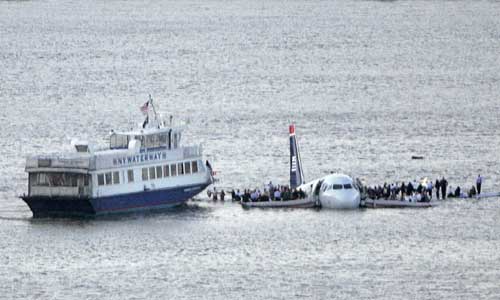
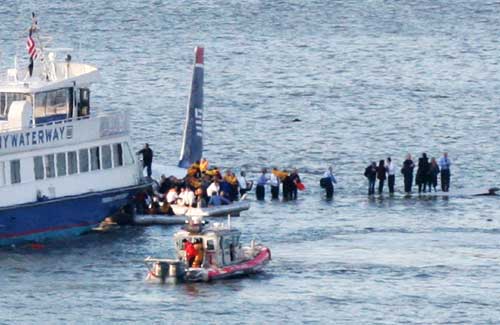
Shortly after the plane hit the water, commuter ferries crossing the Hudson rushed to the scene and began plucking shivering passengers from the wings of the downed jet.
"We were just going home to Jersey," said one rescuer who would only give his first name, Jim. The 40-year-old man, a resident of Belmar, N.J., was on the first ferry to reach the jetliner.
"They were pretty calm," he said of the passengers. "They just wanted to get out of the water. Everybody looked like they were in pretty good shape. They were thanking us. We were just worried about getting them on the boat."
Jim's wife, Susan, 39, said she was astounded to see the plane just floating on the water.
"We just didn't believe what we were seeing," she said. "They were just standing on the wings waiting for us to pick them up."
Some of the rescued passengers were taken to the New York Waterways Terminal, Pier 79, where police officers were seen bringing in cots and blankets.
Mike Benny, an emergency medical technician who arrived at the scene a few minutes after the plane went down, said passengers were calm but were concerned about contacting friends and family members who would be worried. "They were all just basically concerned about their loved ones back at home," said Benny, who turned 37 today. He said he treated about 40 people at the scene.
"Amazingly, most of them were calm," he said.
Westchester residents Jim and Michelle Prisco were driving down 40th Street toward the West Side Highway when they saw the plane go into the river.
"I freaked out," said Michelle Prisco. "I thought, not another terrorist attack."
Jim Prisco said he initially thought the plane was going to hit the George Washington Bridge. He was surprised to see it glide onto the water.
"It looked very gentle the way it landed," he said.
Patrick Wilder, a 35-year-old social worker, was bicycling north along the Hudson River near 125th Street when he saw the plane pass over the George Washington Bridge.
"I saw the plane on the Hudson, and I knew it was in trouble, because that's just not the normal route," he said. "All of a sudden it looked like it was pulling up slightly."
He biked on, then turned around to see the plane go down.
"I saw the splash," he said.
Initially, the plane appeared partially submerged, at about window level of the fuselage, but sinking quickly. Passengers wearing life vests were being helped off the craft.
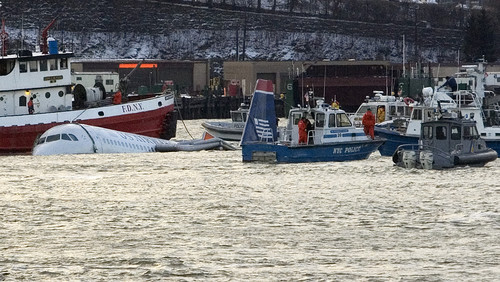
By evening, the plane was being supported by several boats.
On Nov. 12, 2001, American Airlines Flight 587 crashed off Queens, killing all 260 people aboard and five on the ground.
Staff writers Peter Pae and Joanna Lin contributed from Los Angeles. Staff writers Matea Gold and Walter Hamilton contributed from New York.